Wednesday, May 25, 2011

ASM 2011/Upcoming posts and news

As I ready to depart for Panama next week I just wanted to give a few quick updates.  First off, our first commercial project was shown this past week at ASM 2011 in the New Orleans Convention Center, many thanks to Pall Life Science for allowing us to scape the terrarium.  I hope this is just the beginning of this type of work.

In further aquarium news, I'll be posting in the coming days a fairly simple, yet effective hardscape design I did for a 20 gallon long aquarium.  It features some dyed concrete work to simulate an Amazonian river bank.  I'll also be posting the update to the 'Micro Mega Terrarium' which will bring it up to date.

The next updates after that will take place in Panama where I'll be posting some inspirational shots.  Upon my return in August expect bigger and better things.  I'll be ramping up designs for terraria and aquaria and gearing up for some art exhibitions.

Here I leave you with some old aquariums, my first trials into planted aquaria.

10 gallon desk aquarium to grow out plants, and house some beautiful Boraras brigittae


And here my first iteration of the 75 gallon Peru/Colombia themed aquarium, soon after setting it up.  This housed several species of Apistogramma, Nannostomus and various tetras.


Monday, May 16, 2011

The rising waters/where the driftwood comes from

I didn't live in New Orleans during Hurricane Katrina.  It was a few years later that I moved here and ever since I've very much considered it my home.  I'm sure you've heard of the rising waters and flooding in the news.

The funny thing about all the flooding is that we haven't really had any significant rain in weeks and weeks.  It's one thing to think about your house potentially flooding when it's raining heavy and frequently, but here it's not the case.


A few weeks ago I was going for a 'driftwood walk' around the levee to see if there was any nice pieces there.  You can never have enough nice driftwood, even if it just sits in a pile in the back of your house.  I noticed the water was significantly higher than normal and many of my favorite spots were inundated.  


That was well before the news started reporting it.  I blew it off and just figured it would go back down shortly.  Frankly, when ever the water is high I usually get excited about new wood depositions.  


In the photo above is traditionally a good spot for wood.  Now the trees, around which I walk to get pieces, are submerged by perhaps 10 feet plus of water.  These photos are a day after the Morganza Spillway was partially opened and the water is lower than days before.  The peak of the flooding won't be for several days.  


By all accounts, New Orleans will be alright in this flooding.  All measures have been taken to ensure it. It makes me very uncomfortable though that this safety has come with enormous costs to people in the paths of the spillways.  Even though we're not assured safety of our homes and belongings, others have been assured that their houses will be lost.  


When I first moved here I wasn't really sure what a levee even was, aside from raised ground.  It was a word that prior to Katrina, I never really heard used much.  These photos are all from an area called 'The Fly' a park area on the levee where people often have parties and grill.  


The people here are among the friendliest and most diverse and fun in the world.  Just walking around with a big camera gets you lots of shouts and invites to share some food and drink with the parties on the levee.   


I thought a few photos would make this a little more personal for those not in the area.

Saturday, May 14, 2011

A few terrarium orchids that seem happy.

I don't recall when my interest in orchids started, though for the longest time I viewed them as unapproachable, something best left to others.  I had mild success growing an orchid or two as a child, though nothing bloomed.  One turning point was when Mike Shrom took me to an orchid show at Parkside  Orchids.  

Scaphosepalum rapax (please feel free to zoom in on this one, I'm quite fond of the flower)

Their impressive selection and the likes of orchid growers like Lynn O'Shaughnessy helped solidify my interest.  I still didn't think I was ready to attempt growing them, but I knew at some point in the future I would like to try.  


I'm very pleased with how orchids have been doing in my terraria (I've been corrected from previously using 'terrariums')-- and I attribute some success to the combination of misting and high air flow.  I've been playing with different misting strategies to maximize evaporative cooling and drying between sprayings, and I think it's helping.  If anyone wants more detail to the closed circuit air circulation (computer fans) or misting, comment below.


Platystele sp.

The other day I was working at home and I stopped for a minute to see how things were doing in the 'Micro Mega Terrarium' and I noticed a few buds and blooms.  One thing I love about miniature orchids is that you have to look to see them, so surprises are frequent.  

Some Lepanthes coming soon:...


In other news, I have a 20 gallon long aquarium that I've been breeding some Rivulus ornatus that were kindly given to me by Ian Hiler.  I believe I'll be doing a bit of a biotope project on that rescape this weekend.  Stay tuned.

Any help spreading the word to others who may enjoy this blog would be appreciated.  I'm not doing any active advertising so I hope word-of-mouth will work.

Wednesday, May 11, 2011

The Prototype (Kym's terrarium)


As a child I had set up several terrariums, the majority inspired by my herpetological mentor, Mike Shrom. Back in those days Mike's terrariums were a little more stark than his current, mainly comprised of gravel sloping into a pool, covered in a soil mixture and with simple cork bark/coconut huts.  On occasion they were lit by artificial lighting.


Years later I was more interested in plants and the diversity of plants easily accessible increased.  Then came a number of years with no terrariums, mainly when I was traveling the most and living abroad often.  When I started my masters I set up a small planted fish tank, replete with wild strain guppies from Venezuela (known in the aquarium trade as 'Endler's live bearers', after a scientific idol of mine John Endler).  The next year I moved into a new house and set up a larger planted fish tank, next came some salt water aquaria.  Upon moving to New Orleans I had to start over.  I started another salt water tank, but the cost of stocking the tank here was far higher than North Carolina and I decided to sell off what I had and start a terrarium instead.


I had a little wire rack in my room that seemed to be a decent size to hold the terrarium, so I contacted glasscages.com with the dimensions and design ideas.  The one thing I neglected to do was measure my car to double-check that the terrarium would fit through the door openings, rather I measured inside only and figured I was fine.  Luckily the glass was resilient (as was my car) to the rocking and shoving, and I was on my way to starting a new terrarium.  


The background I had planned on doing in tree fern panels or epiweb, and I wanted to try to mount some wood coming from the panels like branches so I could plant them.  The downside of using the wire rack was the depth was restricted, so I was going to try to compensate for that.  I obtained plants from a number of generous friends and got my first orchids from Andy's and I was set.  The only problem was I was leaving for a European tour with a friend's band two weeks after it was set up, and between that and my field season I would be gone for around 4 months.  The goal was that if I was lucky and set things up properly, I would return to a nice and mature terrarium with no input from me, other than initial planting. While this was ended up being true, there were some orchid fatalities from over watering (6x a day misting was too much once the tank saturated). 


One success though was a prototype fan system I designed to allow high levels of air movement, yet by utilizing a closed-circuit design I didn't lose any humidity.  This design element I incorporated into all subsequent designs.


When I moved yet again, into my current "Casa Man Cave" I decided to do a little overhaul of the hard scape to fit in better with the newly built 'Mega terrarium'.  I pulled out all the old hardscape and built a 'tree' out of a number of pieces of driftwood, essentially woven together to mimic buttress roots coming from a central trunk (on the right side).  The result was more plantable space, which turned out to be a great look when covered in moss and bladderworts.  


The major challenge was how to make the background (tree fern) look dynamic with plants, rather than the big, flat open space that it was.  I layered various Begonia species with Selaginella and spaced throughout, Philodendron and Monstera provide further vertical structure with accents of Peperomia and Marcgravia.  I'm very happy with the design now, as is Kym (thankfully...) who is a close friend, neighbor and the current owner of the terrarium.


To date this is the most mature terrarium I've built, and it's always nice to check in on its progress, clip some cuttings and admire it.  For Kym it's been very little work to maintain, which is also a plus.  


If you know anyone who would enjoy this blog, please help spread the word.  If you know anyone who would like a Planted Glass Box, have them contact me.


Monday, May 9, 2011

Planted glass art

As I walk the hallways in the university I occasionally come across piles of old lab equipment with notes encouraging people to take items before they're thrown away.  It's hard to see really neat pieces of glass go to waste.  I've slowly been collecting some of these neat pieces with the intent to try to create some sort of art with them, involving plants.

"Ampules of Evolution"


 This piece of driftwood was a left-over from the 'Micro Mega Terrarium' build.  I liked it so much that it's been sitting against the wall, at the foot of my bed.  Yesterday when sweeping the floor I noticed how well it sat flat in this position against the wall.


 The glass vials I got when we moved a lab and created a shared lab space for shared lab equipment.  They held dried chlorophyll samples that were caked on.  I cleaned them the best I could using a wire brush.  The idea of the contents that they held inspired this piece.


 The first ampule contains some filamentous algae that has been plaguing an aquatic fern in my fish tank.  In this format the beauty of the algae stands out, rather than being a nuisance.

(Forgive the bubbles in these two shots, I needed the ambient light before the sun set)


The next glass piece has some aquatic plants, Cryptocoryne parva, also from my planted aquarium that I snatched out.


 The last ampule has some primitive land plants, a species of moss and some Selaginella from the 'Mega Terrarium'.


"Moss on a log"


Sometimes two things just go together.  This piece of driftwood I collected from what must have been the hottest day of late last summer.  It was something that I never intended to use in a terrarium but it was just too nice to not bring home for some purpose.  I thought about using it around the vegetable garden, that never materialized yet, but it's sat next to my shed for months.


 When I was digging through the glass vials to do a quick inventory of what I had in the shed I saw this large glass, rounded bottomed one.  It has a beautiful cork stopper that fits like a glove.  As soon as I pulled it out I thought of the driftwood piece propped next to the shed.  As luck would have it, these two pieces were made for each other.


 The wood is around 4' long and arcs elegantly, allowing you to put it in several different angles while still holding the glass.


 The moss I have been growing outside since the weather warmed.  It branches out nicely and looks great with the slight magnification provided by the rounded glass.


Those feet are size 13.  They should give you an idea of the size.


Both these pieces are available for sale.  Contact me for details.

The 'Micro Mega' Terrarium, Part 1

As I began designing the current series of terrariums I started with a smaller one that originally sat on a wire rack that I used to store things.  It was a good size (30" x 13.5" x 30") for the space it had to fill, photos of this one I'll shoot tonight as I sold it to a close friend and neighbor.


The first terrarium can be seen to the right in this photo.  Also note, Nick is not a short man-- the terrarium is that large.

As you can see things were a bit off balance between what really wasn't a small terrarium and the 'Mega Terrarium' that I was starting to construct.  I had hoped that wouldn't bother me as I wasn't in a financial position to build two large terrariums in one year.  With the sale of the smaller, first terrarium, I was able to offset the costs of building the third 'Micro Mega' terrarium.

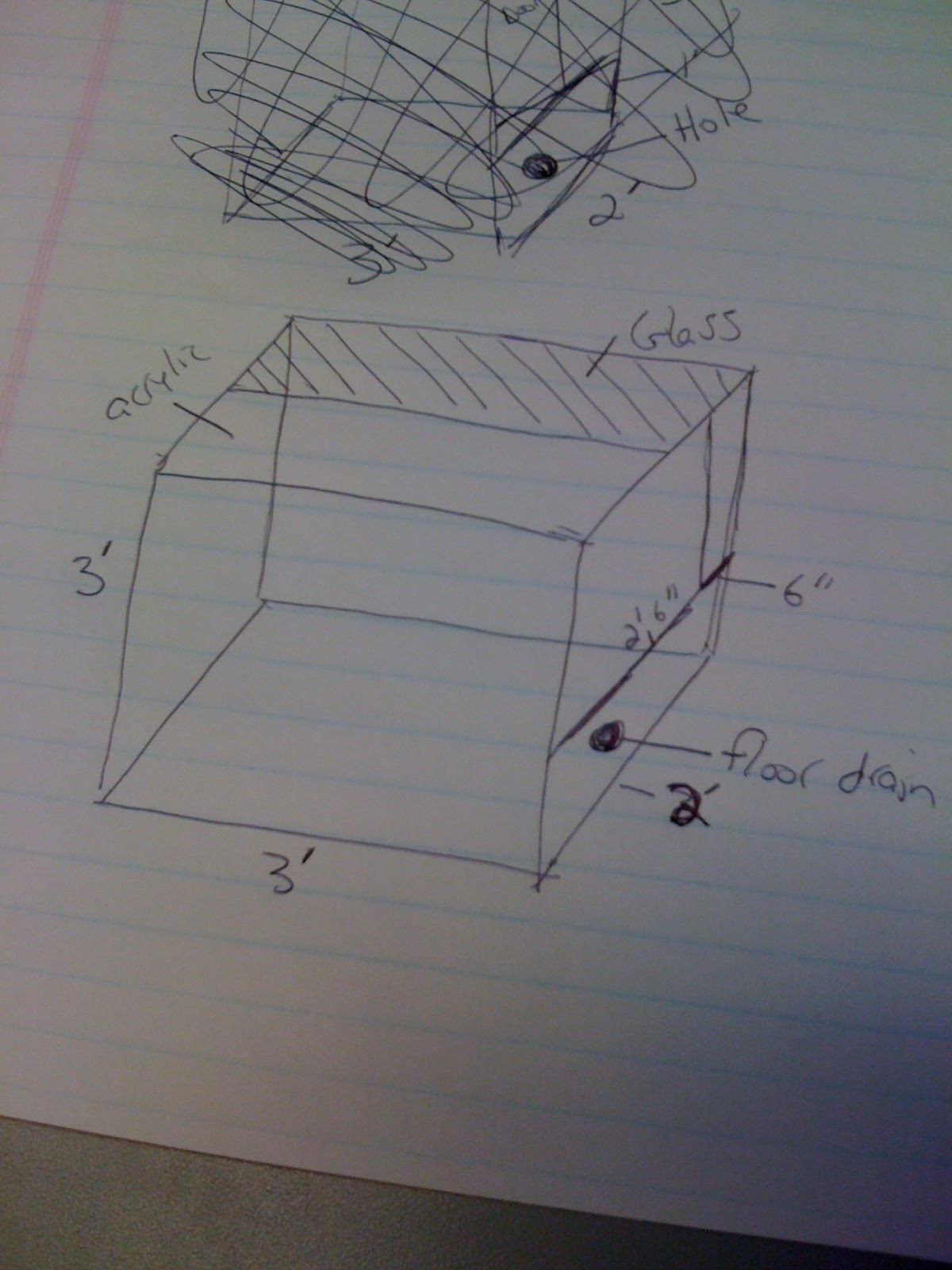
In designing this new one I would take many of the elements I really enjoyed from the 'Mega' and apply them, in some cases with modifications, to the new design.  The height of the 'Mega' I was in love with, though I felt two identical ones would take up too much space in the living room-- and I proved to myself I could work with the height.  With the new design I wanted to keep the same footprint as the dimensions I feel work really well.  I did opt for cutting one foot off the height to give me a 3' x 2' x 3' terrarium.  I also compromised with myself to do two side doors instead of the two large doors on one side, just for ease of maintenance and planting.


Here is the initial sketch of how I wanted the terrarium to be.  Thankfully the manufacturer of my glass terrariums doesn't mind my blueprints-- though we did go back and forth about this design and the stability of the glass with two side doors.  We ended up agreeing on 2 side doors, 1' each, with the back pane of glass supported against the back pane and the side.  I'm very happy with how it work out, so I am not losing much visible space.  I also added thickness to the front and back panes using 3/4" glass with the doors being 1/4".  It's thankfully not as heavy as the 'mega' which is all 3/4" (minus the doors side), so putting it up on the stand was much easier.  


For this design I opted to go a bit outside my comfort zone for the background.  Several years back a good friend, Mark Pepper and I did a terrarium in his basement.  We experimented with some expanding spray foam and covered it with silicon and dirt to make a background.  Several years later the technique is much improved and there's a style involving using a concrete binding agent and a 'coir' (coconut peat).  I had seen it done a few times, and I thought it would be appropriate for this design.  


Over Christmas break I made my annual trip back to Amish Country.  Conveniently, the flight back to New Orleans was out of BWI, so my parents and I could spend a few hours in Inner Harbor before the afternoon flight.  I have been to the aquarium many times over the years, seeing both the exhibits and behind the scenes.  It had been several years since I was there and seeing how the exhibits aged (for the better or worse) was nice.  The one thing that stuck out to me was how solid the hardscape was in the exhibits-- they had a very solid hardscape that doesn't take much to make it look good.  


With this in mind, I decided if I was able to get any faux rocks that looked realistic enough, I would take the risk and work with them.  Nick, a fellow planted glass box enthusiast told me about a young guy in Texas who was producing some nice closed cell foam rocks.  I contacted him and said I'd really like to give them a shot.  A week or so later a large box arrives at my door, far lighter than even I had anticipated.  They were hollow, so I used some old grocery bags (that I recycle and use as trash bags) and then sprayed some expanding foam to fill the rocks so I could silicone them on the background.  I then sprayed more foam around the back and sides, and placed some driftwood branches to give more planting surfaces for the miniature orchids that I've been growing.  


The whole background cured for about a week until I trusted placing the peat mix on it.  When I ordered the rocks I did a quick sketch to anticipate placement and shapes, but nothing prepares you for when you have to design a layout with the terrarium on its back on the floor.  I tried hovering above to arrange the rocks and wood, but it was very difficult to get a feeling for placement.  Yet more difficult was knowing that the design would be elevated on the stand, so anticipating how everything interacted was the hardest part of this hardscaping this design for me.  I mixed the coconut peat (coir) and binder and placed some test pieces on the very bottom.  It bothered me how homogenized and boring it looked to me.  I really love the look and feel of tree fern panels, and this looked too fake to me.  I decided to gather up all the dust and scrap pieces of tree fern I had, and break a few scraps.  I used these pieces to push into the coir  mixture to create more texture in it.  


Once the texture was more to my liking, I began the long and tedious process of letting everything fully dry.  I opted to give it nearly two weeks to be sure I wouldn't have chunks of background falling off in the future, as this is a real concern.  After about a week, I set the terrarium up and placed it on the stand so I could wire up the fans and lights to give it some extra help drying-- though the real reason was so I could see how the wood fit in with the rocks and background.  


Luckily for me, the background dried with no issues.  Even more lucky was a small sale that Tropical Orchid Farm was having on some of my favorite small orchids.  Their temperature zone is perfect for my growing conditions and I've had fantastic luck with their plants-- not to mention they're very generous with the sizes of their plants.  I spaced out a number of small orchids on the branches.  The goal was to have moss cover the spaces between the orchids, so just the leaves stuck out above the moss.  In this design I wanted the main feature to be the rocks and branches, with just walls of small leaves weaving around the rest.  I also wanted to mix textures with leaves of plants like Marcgravia, Peperomia and other neat vining plants.  

Part 2 to follow shortly, detailing the progression of this exhibit over the next few months.